
Fritz Jorgensen/iStock Editorial via Getty Images
Meta Platforms (NASDAQ:FB) has a dual identity. On the one hand, the company is, since Apple’s data policy changes, a legacy business with a declining revenue stream, and on the other hand, it is a very rich startup in the metaverse space. Long the king of the ad tech industry, Meta has taken a body blow at the hands of Apple (AAPL) thanks to Apple’s data privacy changes. Those changes are enough to suggest that Meta’s old business model is dead and management has hinted at such. The company’s history of failed innovations does not suggest that it can succeed as a startup, and regulators have knocked out its ability to generate value through acquisitions. In addition, the company is losing young people. Escaping the straightjacket of history will be hard and Meta is likely to fail. Despite financial metrics that point to a company that has grown value at exceptional rates over the last decade, and which is trading at a discount to the market and its own historic average, Meta is a bad bet. Investors should stay away.
A History of Rewarding Shareholders
Meta has been one of the great investments of the last decade, growing its share price by a compound annual growth rate (CAGR) of over 20% in that time, compared to nearly 12.4% for the S&P 500 and more than 16% for the NASDAQ 100.
Meta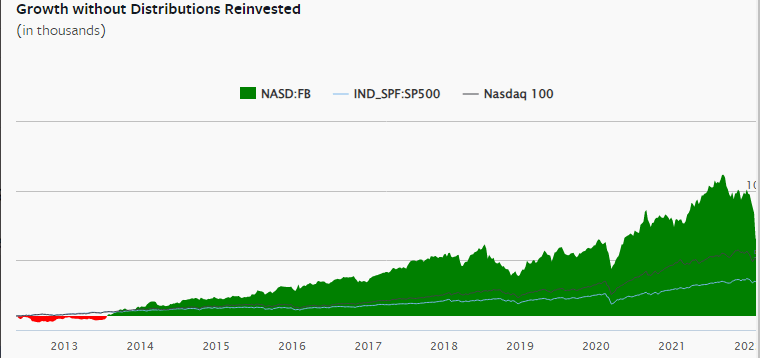
Meta’s stock performance was based on a business model that Liberty Media Chairman, John Malone, once referred to as the “best business model that’s ever been created”. It’s hard to imagine a better business: content on Meta’s platforms was produced free of charge by its more than 2 billion daily active users (DAU). Flywheel network effects drove the value of the platform to stratospheric heights, driving down the marginal cost of ads. The company’s ability to make money is clear from its 80% gross margins. In the last decade, gross margins have never fallen below 72%. Despite investments in research & development (some $25 billion in 2021), new technology, expanding their staff, and other activities, Meta still earns 33 cents in profits for every dollar of revenue spent.
Revenue grew from over $5 billion in 2012 (per its 2012 10-K), to $117 billion in 2021 (per its 2021 10-K). According to the company’s earnings report for Q1 2022, revenue, at $27.9 billion was higher than for the same period last year, which was nearly $26.2 billion. The company’s profitability over the last decade has been exceptional, rising from more than $53 million in 2012 to $39 billion in 2021, compounding at over 93% per year. Meta’s free cash flow (FCF) grew from $377 million in 2012 to over $39 billion in the last decade, compounded at 59% a year. Meta’s return on invested capital (ROIC) has swollen from 0.59% in 2012 to 28.08% in 2021, its highest level ever.
Meta has rewarded investors despite clear signs that the company was struggling to innovate. Failure is a feature of any attempt to innovate. Even at its best, Meta struggled with innovations such as web-based apps, and in the last few years, its Libra initiative has floundered. Failure to innovate in and of itself should not lead to condemnation of the company. Innovation is hard, and Meta had one of the greatest business models in history. The company had a path to continued value creation. However, material changes to the company’s business model, as well as regulatory shifts that have knocked off one of the key drivers of Meta’s value creation, acquisitions, have destroyed the old business model.
Meta’s Appledependencia Has Killed It
When Meta announced that its daily average users had declined for the first time in 18 years, the news resulted in a selloff in which Meta’s share tumbled 25% that day.
Guardian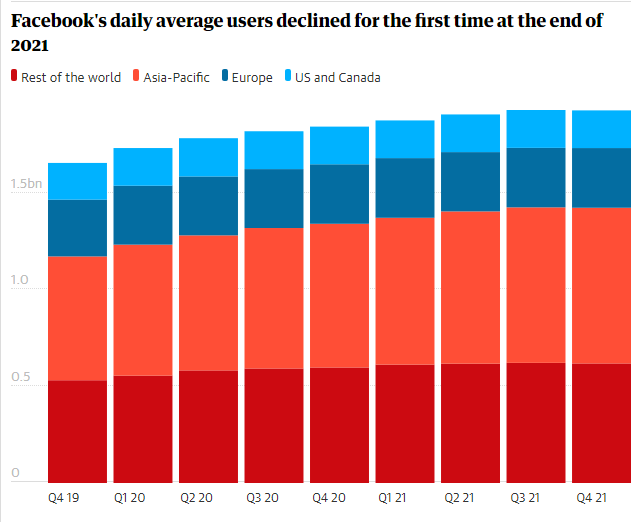
That decline symbolized the end of Meta’s old business model.
In 2018, when Senator Orrin Hatch (R-Utah) asked Meta’s chief executive officer, Mark Zuckerberg how the company makes money, Zuckerberg replied, “We sell ads, senator”.
Meta’s financial results show the truth of Zuckerberg’s statement:
Meta Q1 2022 Earnings Report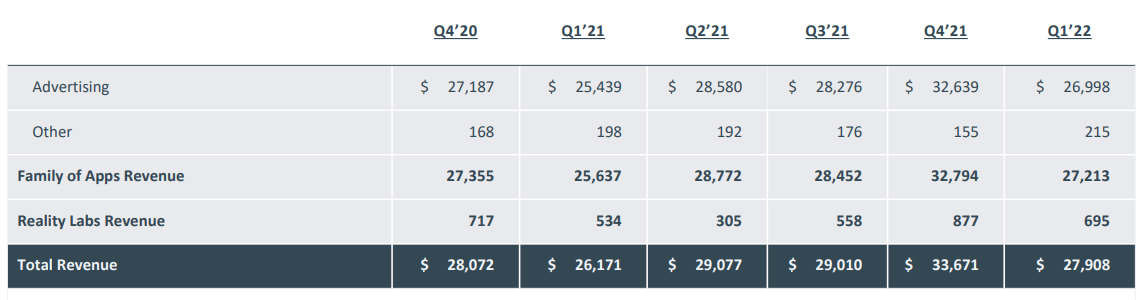
Meta has long been king of the-now $189 billion global mobile advertising industry. It has been a king that has excelled at wringing the most out of its users, with average revenue per user (ARPU) compounding by over 21% between 2011 and 2021.
Statista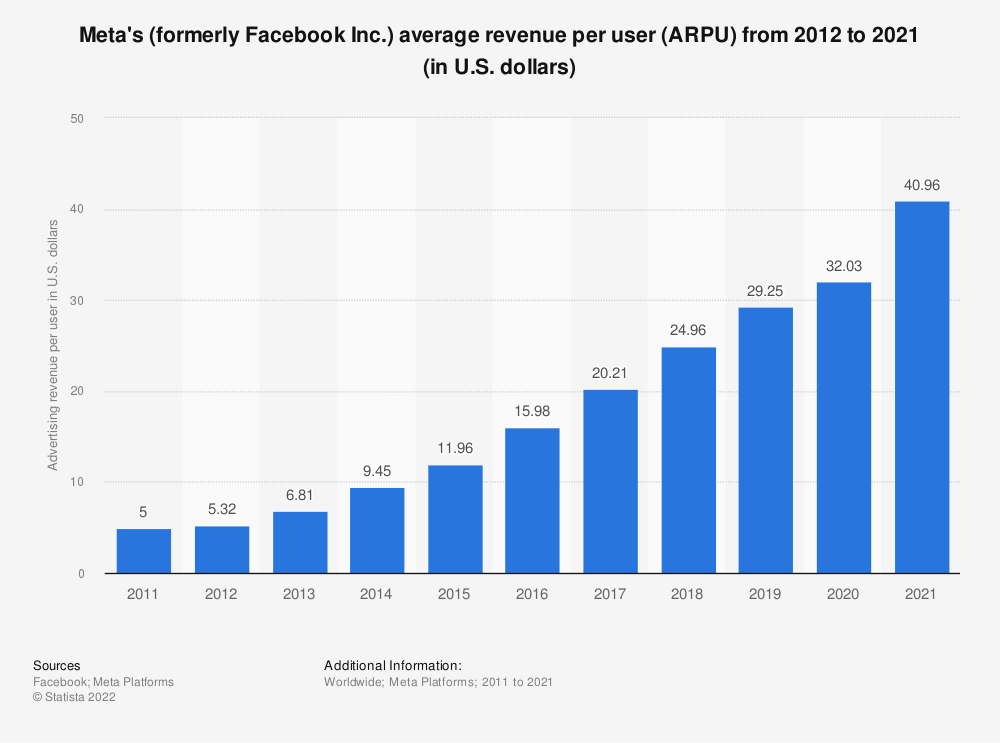
Meta’s unique business model revolves around its Audience Network, which combines the company’s own vast data as a publisher with third-party data as an advertising platform, to show ads to an estimated 40% of the world’s 500 most downloaded apps. In other words, through the Audience Network, Meta has been able to monetize virtually everyone with a smartphone! Meta last reported Audience Network numbers in its Q4 2016 earnings call, when it reached a billion unique people per month. Since 2016, Meta has enjoyed a golden age in advertising revenue, as it expanded the number of advertisers on its platforms.
Yet, Meta’s weakness has always been its relationship with Apple. Apple’s iOS privacy changes are the iceberg that is sinking the Titanic, and Meta understands this. As tech investor Beth Kindig noted, third-party data has always been a crucial driver of advertising revenue, even though the company does not spell this out. Kindig remarked that, “it’s Apple’s device, Apple’s operating system and Apple’s app store. …Apple owns the real estate on iOS, and everyone else is renting”.
As Ben Thompson of Stratechery notes, Bill Gates once remarked that “A platform is when the economic value of everybody that uses it, exceeds the value of the company that creates it”.
Stratechery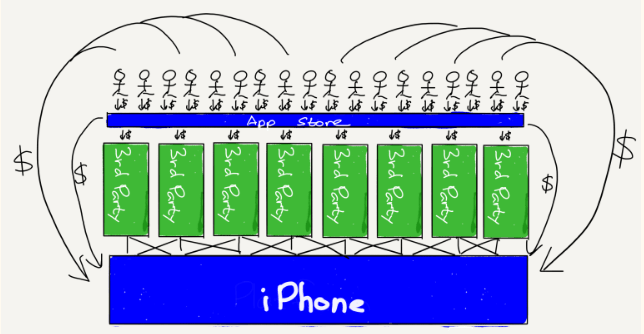
Apple’s changes to its identifier for advertiser’s (IDFA) policy pose a unique threat to Meta. Apple has turned off IDFA by default, requiring its customers to explicitly turn it on. IDFAs are assigned to every device and permit, assuming user consent, advertisers to track user interactions and behavior, and create user profiles for grouping with similar profiles for more targeted messaging across your devices while ensuring attribution to assess the success of specific marketing strategies. The company’s chief executive officer, Mark Zuckerberg, indicated that he believes that these changes will damage revenue by $10 billion in 2022.
Defaults matter. Given the bad press that IDFA’s have, most users are going to keep their IDFA settings at default. Evidence suggests that this indeed has been the case. According to Flurry, as of April 2022, just 25% of people had opted-in to IDFA..
Source: Flurry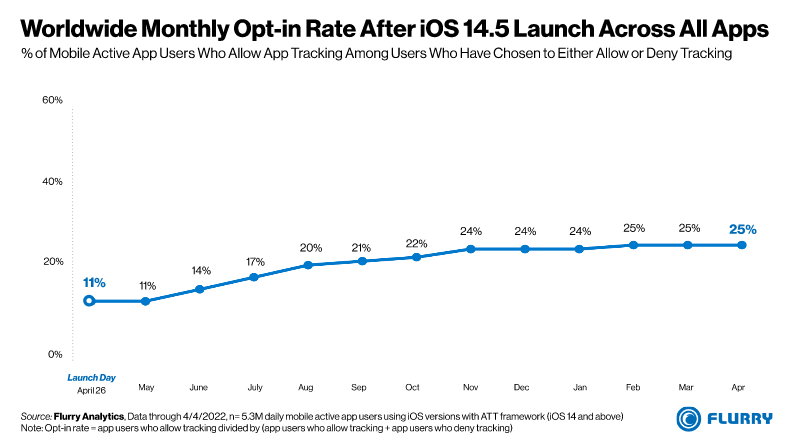
The opt-in rate is low even when the prompt has been displayed.
Source: Flurry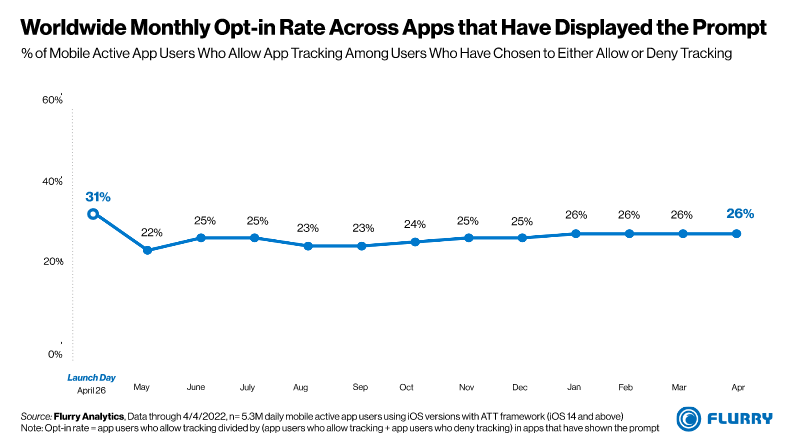
As of August 2018, 3% of users had “restricted status” and could not be asked to be tracked; 48% had not yet been prompted by apps, giving them a default not-tracked status; and 40% had denied tracking via the prompt or the iOS privacy settings.
Meta understood the catastrophic nature of Apple’s changes and waged a fruitless public relations campaign against the changes. The Facebook Papers demonstrated the degree of power that Apple has over Meta, with revelations that Apple threatened to pull Facebook and Instagram from its Apple Store.
Investors have not appreciated the degree of dependence that Meta has on Apple. Indeed, when user growth returned, Meta’s stock soared. All was forgiven. Yet the threats to the business model remain.
Chief operating officer, Sheryl Sandberg said in the Q4 2021 earnings call, that “Apple created two challenges for advertisers. One is that the accuracy of our ads targeting decreased, which increased the cost of driving outcomes. The other is that measuring those outcomes became more difficult.” Meta cannot generate the same amount of economic value it did prior to Apple’s IDFA changes. Specifically, advertisers will have a vastly diminished ability to execute targeted advertising, not only because of the loss of tracking ability, but also because advertisers will not be able to accurately assess which advertising strategies worked, and which did not. The economic value of third-party business has plummeted and Meta is no longer a platform in the Bill Gates sense of the word.
Meta now offers less insightful data to advertisers, and therefore, Meta’s success with IDFA allowed it to offer advertisers the best of all possible advertising worlds/ advertisers could simply tell the company what their targeted return on their ad spend was and the company would automatically calculate how much the advertiser needed to spend to get that return:
In the company’s Q4 2021 earnings call, Chief Finance Officer, David Wehner discussed the impact of these changes, saying:
“…as we go into 2022, we’re going to be lapping a period in which in Q1 and Q2, those headwinds were not in place in the year-ago period. So that definitely makes for a tough comp in the first half of the year.
And we believe the impact of iOS overall as a headwind on our business in 2022 is on the order of $10 billion, so it’s a pretty significant headwind for our business. And we’re seeing that impact in a number of verticals. E-commerce was an area where we saw a meaningful slowdown in growth in Q4. And similarly, we’ve seen other areas like gaming be challenged.”
It should be highlighted that these changes do not uniformly affect the ad tech industry. Whereas Meta is a loser in this brave new world, Alphabet (GOOGL) is a winner. According to Wehner,
“…on e-commerce, it’s quite noticeable — notable that Google called out, seeing strength in that very same vertical. And so given that we know that e-commerce is one of the most impacted verticals from iOS restrictions, it makes sense that those restrictions are probably part of the explanation for the difference between what they were seeing and what we were seeing.
And if you look at it, we believe those restrictions from Apple are designed in a way that carves out browsers from the tracking prompts Apple requires for apps. And so what that means is that search ads could have access to far more third-party data for measurement and optimization purposes than app-based ad platforms like ours.”
The import of this message is that Meta will experience a very significant hit as a consequence of Apple’s changes, and these changes will not affect everyone equally, with Alphabet’s search ads showing strength compared to app-based platforms such as Meta’s. Meta’s dependence on third-party data, compared to platforms such as Alphabet’s, will place it at a disadvantage and make it a loser in this new era in ad-tech. To compete, Meta has to change its business model. The old Meta is dead. In this new world, Meta is a loser but Alphabet is a winner. Absent the third-party data that has allowed it to thrive ahead of rivals, Meta is normalized and the result will, in the long run, lead to lower ARPU.
It is possible that Meta takes a hit bigger than the $10 billion it has guided for. Management pointed out that $10 billion was within a range of estimates and that the hit could be bigger. Furthermore, Sandberg suggested that even if advertisers use some of the tools Meta has launched to close the “underreporting gap for iOS web conversions”, and “deliver better insights for advertisers”, Meta still expects the overall targeting and measurement headwinds to moderately increase…in Q1 and throughout 2022.”
The IDFA changes mean that the value of the Audience Network has been gutted. In its Q4 2016 earnings call, Meta worried that ad load issues would lead to declining revenue. The Audience Network made sure the opposite happened. We do not have figures for Audience Network since then, but it is probable that the numbers will worry Meta’s executives.
Meta is Losing the Attention Wars
The Audience Network is under threat not just from IDFA changes but from a deterioration in first-party data uploads and attention paid to its apps.
Meta’s Reels, Stories and Feed are designed to capture attention and no company, for good or for ill, has been better at getting eyeballs on its content than Meta. Yet, in the last few years, new entrants such as ByteDance’s TikTok, have started to diminish Meta’s ability to capture attention. User growth is in secular decline.
Source: Statista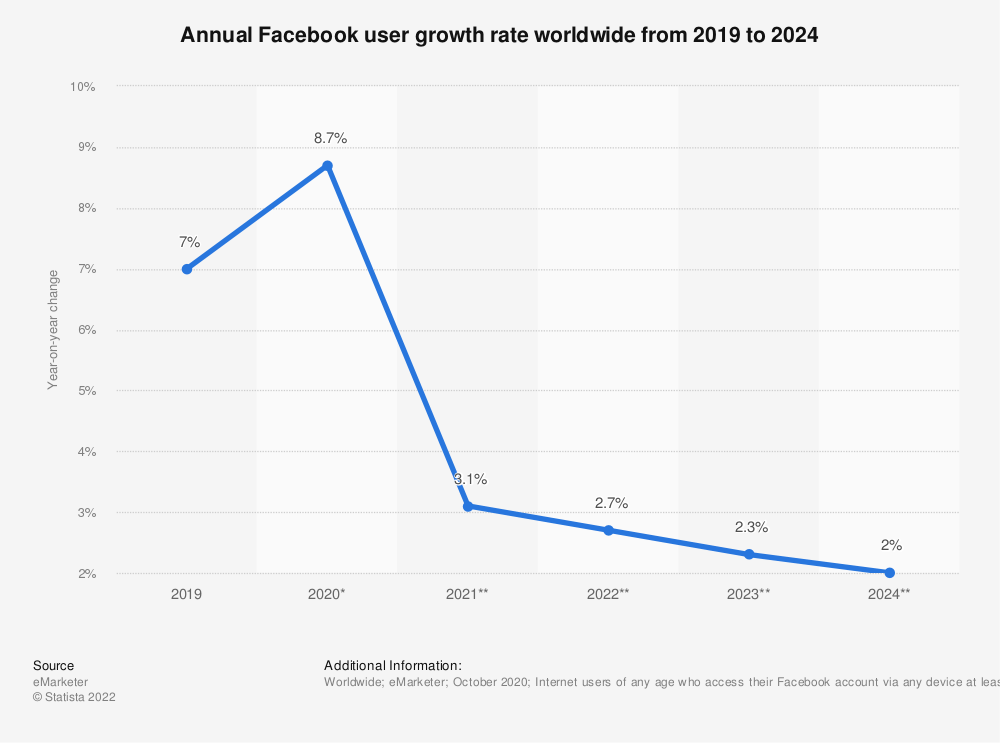
This is important for advertisers, who budget their spending based on where they believe their money will be most efficiently deployed. Meta’s calling card for so long was simple; advertising on its platforms got advertisers on the biggest family of town squares in the world.
The Facebook Papers showed that Meta has been struggling to command the attention of younger users, who have increasingly shifted to upstart apps such as the wildly successful TikTok. Indeed, in the Q3 2021 earnings call, Zuckerberg admitted as much. The company’s stock plunge earlier in the year reflects Meta’s diminishing status in the world of social media. With declining product-market fit has come an erosion of its sustainable competitive advantage.
Regulators Have Knocked Out a Value Driver
Meta’s genius is not just about its main app, Facebook, it’s about the acquisitions it has made, such as Instagram, and WhatsApp, which have added enormous value to the company. However, the Cambridge Analytica scandal led regulators to knock out a key value driver in a company that has struggled with innovation.
Although it’s likely that Cambridge Analytica oversold its abilities, Meta has become one of the most reviled companies in the world. For regulators and politicians, Meta is a malign actor that needs to be stopped. fear of its power extends to the European Union, Australia and other key markets. Although it’s true that Big Tech, in general, has suffered a reputational decline, Meta is especially affected by this. For instance, Alphabet has largely escaped some of the vitriol thrown Meta’s way.
The reputational hits that Meta has suffered are an important reason why the then-Facebook rebranded itself as Meta Platforms, the “social metaverse company”.
Although it is unlikely to be broken up, Meta is under de facto sanctions from the Federal Trade Commission (FTC), which has essentially signaled that it will not approve any major acquisition by Meta. So, for instance, when ByteDance flirted with the idea of selling TikTok to an American company, Meta was not in the conversation. In the United Kingdom, the Competition and Markets Authority (CMA) killed the Giphy deal.
The FTC is pursuing a case in which it alleges that Meta pursues a “bury or buy” acquisition strategy, so the prospect of any meaningful deals in the near-term are slim-to-none.
Monetizing the Metaverse is at Least a Decade Away
Zuckerberg has bet the future of the company on the metaverse. He understands that the core business is eroding. In Zuckerberg’s Keynote last year, he acknowledged that Meta is building technology that does not yet exist. In an interview with Ben Thompson, he admitted Zuckerberg said that the metaverse was something the company was “hoping to build over the next, I don’t know, call it ten years”. It’s interesting to note how he described the metaverse and the work that needs to be done to get there:
“This is a big topic. The metaverse is a vision that spans many companies – the whole industry. You can think about it as the successor to the mobile internet. And it’s certainly not something that any one company is going to build, but I think a big part of our next chapter is going to hopefully be contributing to building that, in partnership with a lot of other companies and creators and developers. But you can think about the metaverse as an embodied internet, where instead of just viewing content – you are in it. And you feel present with other people as if you were in other places, having different experiences that you couldn’t necessarily do on a 2D app or webpage, like dancing, for example, or different types of fitness.”
The media has gone gaga over the metaverse and every tech CEO worth their salt has thrown “metaverse” around in an earnings call, letter to shareholders, or some other address. Yet, as Zuckerberg hinted, the metaverse is not imminent.
The simplest technology will only be available over the next 3-5 years. The metaverse requires radical innovation in semiconductors, data centers and networking computers, and right now, nobody knows how to get there. The most obvious barrier is the global chip crunch. There are simply not enough chips to make the metaverse happen.
The supercomputing power needed to make the metaverse happen is years away from development. The horsepower simply does not exist and will not exist within the near term.
Raja Koduri of Intel estimates that, “Truly persistent and immersive computing, at scale and accessible by billions of humans in real-time, will require even more: a 1,000-times increase in computational efficiency from today’s state of the art.”
Risk to Thesis
Meta has enabled a slew of businesses, particularly direct-to-consumer (DTC) ecommerce companies, to develop on Facebook and its other platforms. These businesses have been particularly attracted to Meta’s platforms because of their ability to mobilize granular data about its users. In addition, Meta has created direct-to-consumer businesses that simply could not exist outside the internet, or more specifically, Meta’s platforms.
In its Q1 2019 earnings call, Meta reported that its top 100 advertisers made up less than 20% of its ad revenue. The bulk of that year’s $69.7 billion in ad revenue came from its more than 8 million advertisers. The long-tailed nature of the company’s revenue source is due to its fully automated ad-buying system.
Ben Thompson of Stratechery has argued that this makes Meta antifragile, and this was highlighted by Meta’s strength as big brands boycotted it in 2020: direct response rose not simply along with the decline of brand advertising but as a function of brand advertising’s decline. By exiting the market for Meta’s limited inventory and not buying ads, brands simply ensured that those who remained in the market enjoyed a more efficient spend, raising their expected profit to an amount capped by the incentive of those firms who remained behind, to increase their spending.
Similarly, although a segment of advertisers may choose to stop buying Meta ads, or to reduce their spending, those businesses who choose not to do so will experience a more efficient spend, and be induced to increase their spending on Meta’s platforms. The result may be that once again, Meta proves antifragile, thanks to its long-tailed revenue stream, and overcomes its problems. In this way, Meta may stop being a frontline company but remain a profitable one.
Lower prices for ads on Meta’s auction system, as a function of a segment of advertisers leaving the company, may impact revenue, but with the proviso that those firms that could not exist outside of Meta will use those lower prices to increase their spending and lift Meta’s numbers.
It is important to realize that many third-party ad tech companies depend on Meta for their relationship with their customers, and so, they have a huge incentive to remain on the platform. Meta still offers a superior tool for app install ad campaigns, beating Apple’s own alternative, SKAdNetwork.
Finally, Facebook Shops is an example of how the company’s backwards integration is allowing it to capture more value from third-party payment solutions, who are negatively affected by Apple’s policies on cookies. These policies hurt the customer experience of DTC online stores, making it more attractive for them to shift to Facebook Shops.
There is a school of thought that advertisers do not make allocation decisions based on data insufficiency; but in terms of size of the audience, and given Meta’s size, advertisers will continue to allocate funds to Meta, and focus on working out how to optimize the data they do have. So although it is likely that there will be a deceleration in ad revenue, there may be a high floor for how much ad revenue Meta receives. That will allow Meta room to reconstruct its ad business. Indeed, Sandberg said in the Q4 2021 earnings call, that,
“On the question of what we need to see to rebuild ad products and continue to grow return on ad spend, in the short run, as I talked about, we’re working on measurement.
We’re rolling out new ways to help businesses continue to measure campaigns using Apple’s SKAd Network API and Meta’s Aggregated Events Measurement and conversion modeling.
…Over the longer term, we need to develop privacy-enhancing tech to help minimize the amount of personal information we learn and we use. Use more aggregate, use more anonymized data while still allowing us to show relevant ads and that’s going to take us time.”
With room to reconstruct, the company may veer past disaster. Indeed, operationally, it’s not a given that advertisers will see a weakness in their spending: Meta is paid based on how many people click on ads (cost per thousand clicks, or CPM) and how many people installed apps (cost per install, or CPI). This is not the same thing as sales. Of course, given Meta’s size, the bet is that getting enough eyeballs on an ad and converting just a fraction of that into sales is worth paying for all expressions of interest. Again, someone could argue that it is Meta’s size that matters, rather than its ability to optimize data. Revelations about how Cambridge Analytica oversold its claims do suggest this.
Valuation
The decline in users was in itself symbolic, falling from 1.93 billion in Q3 2021 to 1.929 billion in Q4 2021, a decline of just 1 million users. Today, Meta is trading at a price-to-earnings (PE) ratio of just 16, against a 5-year average of 28.79. Compared to the S&P 500, whose PE ratio is 21, the company seems to be deeply undervalued. The company’s free cash flow (FCF) yield, at 6.98%, suggests that this giant company is a buy. Any investor knows that buying growing FCF at attractive prices is a winning strategy. However, this is one of those times where these signals are false, because, as we have seen, the company that thrived in the last decade, no longer exists.
Conclusion
Meta has reached the point at which its very viability can be called into question. The company has struggled to innovate, it is losing the attention wars, Apple’s IDFA policy changes have destroyed its old business model, regulators have taken away a key value driver, and its biggest bet relies on innovations which have yet to be made. The metaverse may be realized and Meta may be a leader in that industry. However, investors have to start thinking of Meta as both a very rich metaverse startup, and a legacy business with a declining revenue stream. That implies a lot of uncertainty. Meta has not succeeded in the past at the kind of innovation it takes to be a successful startup once again, and it lacks the ability to buy value through acquisitions. The odds suggest that Meta the declining legacy business will define its financial performance rather than Meta the very rich startup.


